Teaching Philosophy
As a teacher the most important part of my job is to build relationships with my students. Having a strong bond with students means that they will behave better for me, that they will trust me to ask for help and that I can best know their needs in both an academic and pastoral sense. Teaching for me is a reciprocal relationship and in order for that relationship to work both student and teacher need to have trust in each other. As a teacher my philosophy is that once you build that trust all the other work that needs to be done in the classroom will come much easier.
Goals
Increase the use of kupu Maori in the classroom by:
- Using as many kupu Maori as I can including greetings and everyday words
- Incorporating kupu Maori and concepts from Te Ao Maori into my lesson plans.
Develop deeper curriculum knowledge for English by
- Identifying the curriculum strands and AOs that my ATs are using in their lessons
- Picking one Key Competency from the curriculum to focus on developing in each of my lesson plans.
Week 1 – Coming out of Lockdown
I started my first week of practicum in lockdown. On the first day we were in level 3 and I contacted my ATs to find out what was happening this week. Since the level change announcement was happening on Tuesday both my ATs told me to wait until we heard what was happening for the week to decide our course of action. They told me that if we were moving down a level later that week then planning online lessons for that week was unnecessary and that we should focus on the return to school at the end of the week. When we got the announcement that we would be moving to level 2 on Thursday this is what happened. However my kids had a slight cold on Wednesday so I took them for a Covid test and while I was waiting for the results I missed school on Thursday so Friday was the first day of my Practicum.
On Friday I had my first day back. First period was the Year 9 English class. You can definitely see that they have been away for 3 weeks as they are finding it hard to focus and are quite silly. They are choosing topics for their speeches. Fourth period was Year 11 English and they are focusing on the Connections Standard (English 1.8). My AT has asked me to think about ways that we can scaffold that learning, that is making connections between texts.
Goal Development:
Goal 1
Since I was only observing this week the only place that I was able to use te reo maori was in my greetings of the class, students and fellow teachers.
Goal 2
Because I was only at school 1 day this week it was challenging to work on my goal. Both ATs and Students were struggling to get back into the routine of being a school. In my Year 9 class students were working on picking topics for their speeches. They had been given the prompt “Something that concerns me that should concern you”. My AT and I moved around the classroom helping students understand what sort of topic they would pick. The key competency in this lesson seemed to be “Managing self”. That is the students were coming up with their own topic which the teacher has to sign off on. An interesting incident was that one of the students asked if he could do the topic of “Alternative uses for Condoms”. My AT told him that he could possibly do it if he took it seriously. My AT told me later that she thought she was mistaken in telling him he could possibly do it as he was too young to take such a topic seriously. Indeed he spent the rest of the lesson being really silly about it. It is interesting to reflect that for Year 9s “Managing Self” still requires some management from teachers in a way that perhaps with older students it would not.
Week 2
When returning to Tawa College I discussed with my ATs the possibility of observing and teaching in a class that required some more classroom management. One of my ATs suggested her Year 12 English class that needed some more motivation. On observing this class, I noticed that there is a group at the back of the class who has some issues with motivation. When discussing this with my AT, we noted that one of (but not the only) reasons that that particular group is having issues with motivation is the way the classroom is set up. There is a corner of the class with a computer that students can use with a collection of desks around it. The computer has to be there because of the powerpoint, but it means that it is challenging for the teacher to get close to the desks to observe what the students are doing. In two of my classes in this room the students who don’t want to work have chosen that spot as their place to sit. This is interesting for me to observe that how a classroom is set up can motivate or demotivate the students.
Goal Development
Goal 1
In my lesson for teaching about Structure in class I made sure to include titles and significant words in my slideshow in Te Reo Maori. For example I used the Title “Whakatakotoranga mo nga tuhononga” – Structuring your Connections and included the words “Timatanga Korero” and “Kupu Whakamutanga” for Introduction and Conclusion. In my teaching practice I try to use the idea of Ako, that is I make my teaching a reciprocal practice between student and teacher. In my lesson plans I try to include as many options for the students to work out the information before telling them. So I constructed my slideshows so that there is a slide such as “Introduction/Timatanga Korero” which has just a title so they have a chance to tell me what they know about the topic before I give them the information.
Goal 2
I planned a lesson around the key competency of Participation for my year 9 class doing speeches. As I have a background as a drama teacher I wanted to use some of those skills to help students who did not feel comfortable standing in front of the class to give a speech. After doing some drama type warm ups, we played the game “Um, Ah, Yeah, Nah”, in which a person has to stand up in front of the class and talk for a minute on a topic without saying the words “Um, Ah, Yeah or Nah”. They are also not allowed to fold their arms or put their hands in their pockets. No one had to participate, but each had the opportunity to participate and I gave chocolate to the people who managed to make it to one minute. The relaxed and fun atmosphere meant that students who I wouldn’t have expected to go up and have a go took a term. It is nice working with the junior students who are not as bogged down as the seniors with assignments. It makes me think that for working with those Y9 and Y10 students there is the opportunity to create opportunities for participation using a slightly more relaxed style as they don’t have as much pressure on them as they don’t have NCEA looming.
Week 3
This week my AT and I focused on marking experience. She gave me some DGAs (Derived Grade Assessments) to practice marking. This was helpful because the DGA was on the topic of I am not Esther, a text that I spent some time teaching in Practicum 1A. I was able to see the effect on our work in the classroom on the work the students were producing. One of the things that stood out in our discussion was that most of the students had a grasp on analysis of the text, they were lacking in their ability to understand the significance of what we are learning to the world outside of the text. My AT and I discussed how we could use this to inform our teaching in the class right now, that is by including more support for what they are lacking.
Goal development:
Goal 1:
I continued this week to try and use more Te Reo Maori in the classroom. In a weekly professional development session hosted by the school it was discussed that there would be an implementation of a set of awards for Maori students. The awards are each named after an Atua Maori and will be awarded to Maori students based on the attributes they possess that relate to each particular Atua. This session helped me to think about more ways that I can incorporate concepts from Te Ao Maori into my teaching practice.
https://maaori.com/whakapapa/ngakete3.htm – The legend of the 3 kete.
Goal 2:
In my year 12 class there is a clear lack of motivation. So in my lesson planning I focused on the Participation key competency. Since it is hard to get the class to work independently, I decided to scaffold the lesson so that students have the opportunity to participate without having to self manage which is another thing that they were struggling with. The lesson was on the short story Harrison Bergenon by Kurt Vonnegut. The story is satirical, but quite dense so to gain some buy-in from the students I showed them some lighter satire to examine satirical techniques but also to gain some buy-in from them because these videos were fun to watch. They then compared the techniques in the fun satirical videos to the ones in the story in small groups. My scaffold of this class was: gain some buy-in from them, show them examples of the work I wanted them to do and then give them a chance to do it themselves.
Week 4
Motivation was low from both students and teachers this week as it was the final week of term. There was lots of revision and working on assignments happening in class. For me as a student teacher there were lots of opportunities to connect with students in these less structured lessons. Connecting with students seems an important part of the teaching process to me. One of the discussions that stood out to me was the conversation with some girls in my year 12 class about etiquette in the drama class. They indicated to me that their drama teacher had encouraged them to do things in class that had made them uncomfortable such as telling them to do something to make a scene more “sensual”. However they were under the impression that in drama class as well as in a career as an actor that they would often be asked to do things that made them uncomfortable. I told them that that is untrue and that many actors have good careers without doing things that make them uncomfortable or things that are sexual on stage or screen. It was a great moment for me because I could see that they were really relieved. As a teacher for me it is more important that the students are safe and comfortable in a drama class. It is important to remember that these are still children.
Final Goal Reflection:
Goal 1:
Because we lost a week of practicum because of lockdown, this practicum felt very rushed. My ATs were spending a lot of time getting students caught up on the work they had missed as well as getting back into the rhythm of school life. Figuring out which lessons I would teach was also something that was rushed. I feel like in this rush my usage of te reo Maori is something that was given the least attention. I used as many words in te reo as possible in the classroom, such as “morena” “e tu” and including te reo maori translations for my slideshow titles. I also included the concept of “ako” in my teaching practices. For me this takes the shape of a reciprocal relationship between me and my students. This can be seen in things like co-constructing learning with students and taking time to build interpersonal relationships with my students. Going forward into my next practicum I will attempt to further clarify Te Ao Maori concepts in lesson plans.
Goal 2
One of the things I realised when trying to achieve this goal was the importance of using the curriculum when planning lessons for the junior students. When planning my appraisal lesson for the Year 9 class , choosing one key competancy to focus on in class gave me direction for their learning. While planning lessons for the senior students I had been relying on the standards for a particular unit to give me direction. Without having this for the junior school, I could focus on the key competancies as outlined in the curriculum. In my next practicum I will look at how I can use the curriculum and the standards side by side with the senior students.
Practicum Make up Days
My time in Te Whare Awhina, the learning support classroom was short but eye opening and definitely worthwhile. The special education unit at Tawa College is only a partial unit. Students come to Te Whare Awhina for their core lessons, for example the junior students come for literacy, numerously, social studies and health, and then go to mainstream classes for options such as music, drama and art. Most of the students in Te Whare Awhina are autistic but they are all verbal. However they have what is classed as low level learning ability which means that they do their course work at around level 1 and 2 of the curriculum.
I was interested in visiting this classroom as I am autistic and ADHD and am interested in special education as an area of teaching. When I first visited the classroom in term 2, I approached the students the way that I would have approached students in a mainstream classroom, that is I went around to each student and talked to them individually. However this did not work with these autistic kids as they are unsure about social cues and approaching them directly made them uncomfortable because they did not know how to react. None of them talked to me. So when I returned to the classroom I was mindful to take a different approach, that is to let the students come to me. On the first day I arrived the teacher gave the students a couple of options, colouring in pictures or doing some Halloween paper crafts. Instead of offering to help some of the students with their crafts I decided to take on of the more challenging crafts, making a cube jack o’lantern and do it myself. These sorts of tasks can be challenging to autistic kids who may or may not have the dexterity to put together an object such as this but may also struggle with the visualising a 3D object when they are only given a 2D piece of paper. After I had made my jack o’lantern, one of the students who had also been attempting to make one brought his paper over to me and asked me to finish cutting out his template. I suggested the next thing he might do might be to fold along the dotted lines. Once he had done that he was able to see from my jack o’lantern what it was supposed to look like and he was able to construct his.
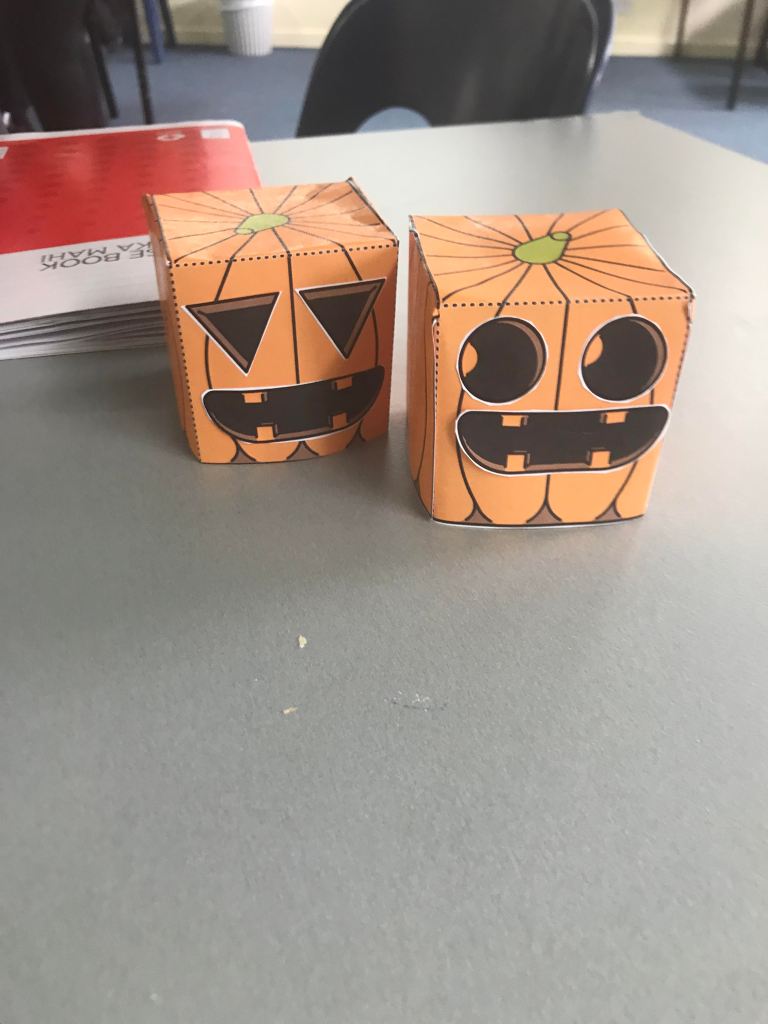
I was pleased that my strategy of demonstrating what we are doing and allowing him to come to join in with me when he felt comfortable worked. This was a strategy that allowed me to connect with other students in the classroom over my time there, including having student talk to me about their weekends as well as doing their reading work with me.
 Julia Campbell